The Cheapest Accessibility Fix Is the One You Prevent
Accessibility often feels expensive because teams find preventable issues after decisions have already spread.
Long description of feature image
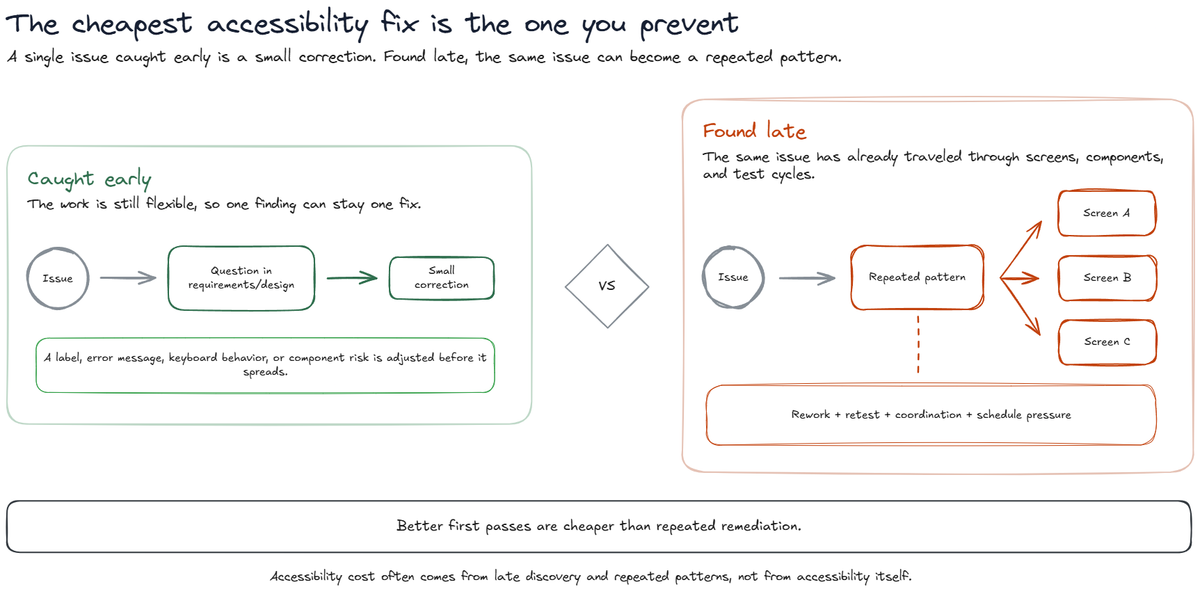
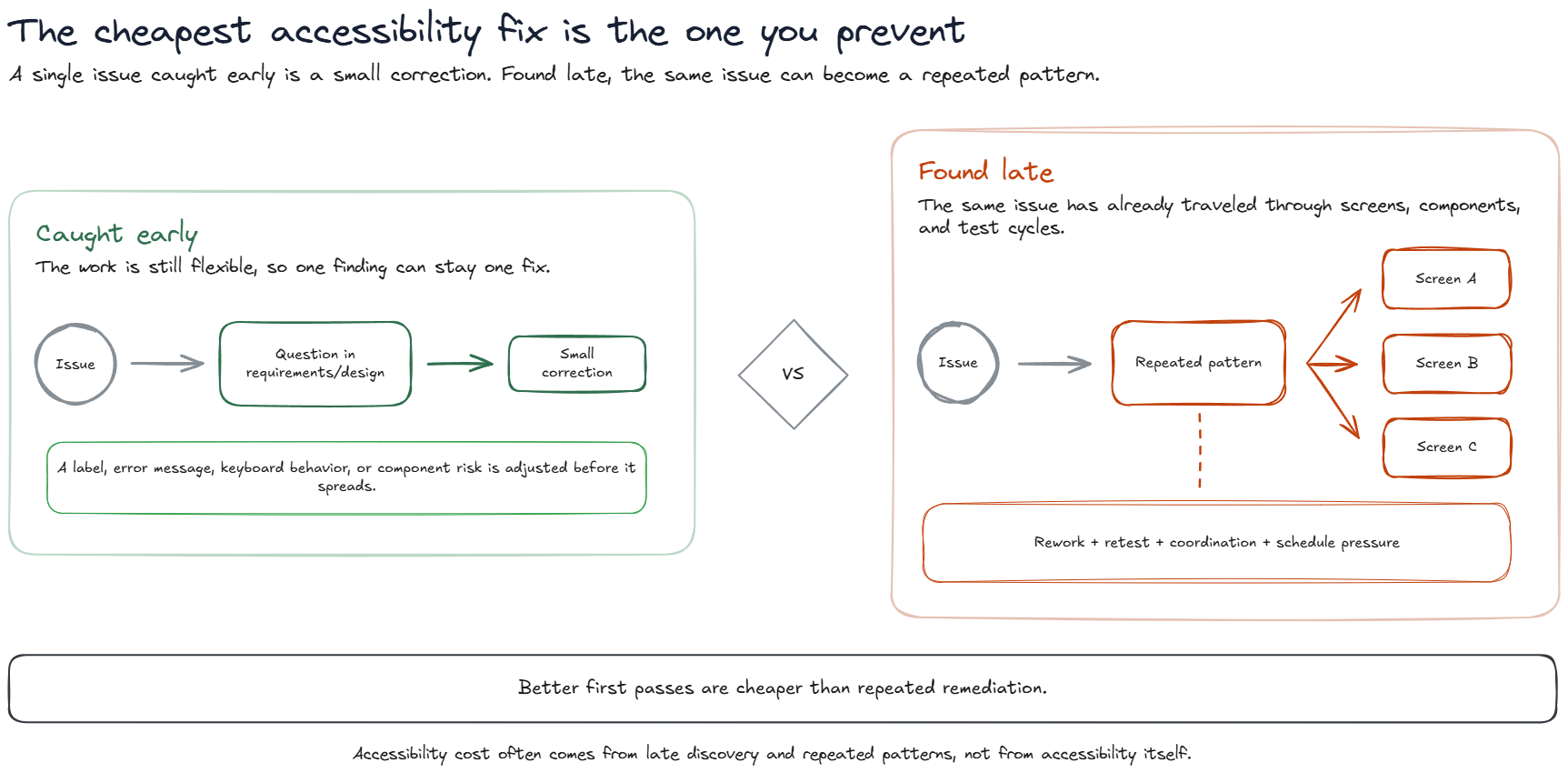
The diagram compares one accessibility issue caught early with the same issue found late. In the early path, the issue becomes a question in requirements or design and then a small correction. In the late path, the same issue has become a repeated pattern across multiple screens and a component, leading to rework, retesting, coordination, and schedule pressure. The main takeaway is that better first passes are cheaper than repeated remediation.
The cheapest accessibility fix is the one your team does not have to make late. I know that sounds obvious, but it changes how we talk about accessibility cost.
Accessibility findings often feel expensive when they arrive after the product has already taken shape. The screen exists. The component has been reused. The team has already planned around a certain version of "done."
Then someone finds an issue that looks small at first--a missing form label; an unclear error message; a focus problem; a color-only status; a button that works with a mouse but not a keyboard.
One issue becomes many fixes.
That cost is not always because accessibility itself is expensive.
Often, the cost is late discovery.
A label question caught during requirements may be a quick clarification. The same pattern found after build may mean remediation across a whole set of screens.
A keyboard issue caught in a reusable component may be one focused fix. The same issue found after that component appears everywhere can become coordination, retesting, and schedule pressure.
A confusing error message caught while writing acceptance criteria may be a sentence change. Found after development, it can involve design, code, QA, and another review cycle.
That is where prevention matters.
Prevention does not require everyone to become an expert. It does require teams to notice common risk patterns earlier:
- Are we defining accessible behavior before build?
- Are we reusing components that have already been checked?
- Are errors, labels, and instructions clear before the screen is coded?
- Are we testing with a keyboard before final review?
- Are we asking vendors for evidence instead of only accepting claims?
Better first passes are cheaper than repeated remediation.
That does not mean teams will catch everything—they will not. But each preventable issue caught early is one less surprise at the end, and one less pattern that quietly spreads through the product.
AI-assisted draft. Final edits by me.